Resources
Aluminium finishes for coastal and high-UV projects
Published 2026-08-02
A finish that performs perfectly on an inland office block can look tired in three years on a seafront tower. Salt air and high UV attack aluminium finishes through completely different mechanisms, and the specification that handles one does not automatically handle the other. This is the conversation we have with customers whose project sits near the sea, at altitude, or in the subtropics — and it is worth having before the tooling is made, not after the first inspection.
Two different attacks, two different failures
Salt is a corrosion problem. Airborne chloride settles on the surface, holds moisture against the metal, and goes looking for any route to the aluminium underneath — a pinhole, a cut edge, a scratch from installation, a poorly sealed anodic pore. Once it reaches the substrate it works sideways under the finish. The visible symptom is usually not fading; it is blistering, edge creep, or white filiform lines crawling out from a scratch.
UV is a polymer problem. It does not touch the aluminium at all — it breaks down the resin in an organic coating. The symptoms are fading, loss of gloss, and eventually chalking, where the surface turns powdery to the touch. Anodizing is essentially immune to this because there is no polymer to degrade.
That asymmetry is the whole point: **anodizing is inherently stronger against UV, powder coating is easier to specify heavily against salt.** Which matters more depends on your site, not on which finish is 'better'.
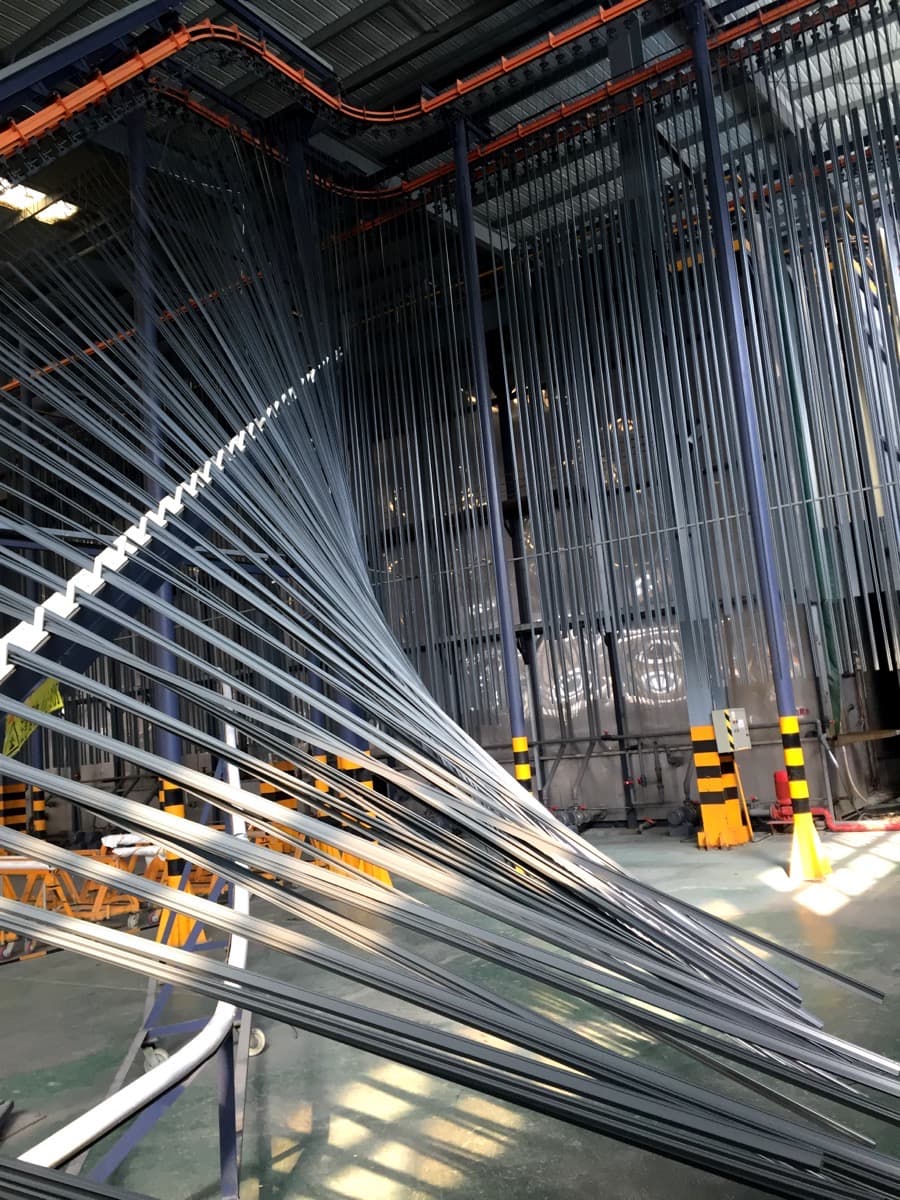
What actually fails first — and it is usually not the flat surface
In our experience the flat face of a well-finished profile is rarely the first thing to go. Failures start at discontinuities: cut ends, machined holes, drainage slots, and any surface damaged during transport or installation.
This matters for the specification because it shifts the emphasis. On a coastal project, how the fabrication sequence is ordered can matter as much as the finish itself — a profile cut and drilled *after* coating has bare aluminium at every one of those edges.
Where the design allows, finishing after fabrication removes that whole class of weak points. Where it does not, the cut edges need to be part of the conversation rather than an afterthought.
Pre-treatment is the part nobody asks about
Buyers compare finishes. They almost never ask about pre-treatment — which is where a large share of real-world coating failures actually originate.
Powder coating adheres to a chemically prepared surface, not to bare aluminium. If that preparation is inadequate, the coating can look perfect on delivery and lift years later in exactly the marine conditions that expose it. The coating grade written in the specification is meaningless if the preparation underneath it is not held to the same standard.
So when a coastal project is being quoted, ask what pre-treatment the line runs — not only what powder is used. A supplier who cannot answer that question clearly is telling you something.
When anodizing is the safer call
High UV with a metallic aesthetic — anodizing does not fade, because there is no polymer to break down. On a long façade this also sidesteps the risk of one elevation weathering differently from another.
Surfaces exposed to abrasion — wind-driven sand near the coast is abrasive, and the anodic layer is part of the metal rather than a film sitting on it.
The trade-off is colour. Anodizing gives the aluminium palette — clear, champagne, bronze, black — not a RAL number, and some batch-to-batch shade variation is inherent to the process. On a large single-colour elevation that variation is visible in a way it never is on a window.
When powder coating is the safer call
The colour is fixed by the design and it is not in the anodized palette. This is the most common reason, and it is a perfectly good one.
Colour consistency across a large elevation matters more than ultimate hardness — powder is far more repeatable between batches.
The specification calls for a particular coating grade and warranty structure. Architectural powder systems come in grades intended for exactly this, and the higher grades exist because marine and high-UV sites need them. Which grade a project needs is a decision for the specifier — what we need from you is which one the specification calls for.
What to write in the enquiry
Say where the building is and how far from the sea. "Coastal" covers everything from a hundred metres of direct salt spray to five kilometres inland — and they are not the same problem.
Say whether the parts are cut and machined before or after finishing. This single line changes the risk profile more than most people expect.
Say if the elevation must be one continuous colour, because it affects how the order is batched through the finishing line.
And ask for the reports. Coating-thickness and salt-spray testing are part of our standard quality checks, and the results are available on request — asking for them costs nothing and keeps any supplier honest.
Related
Profiles in this guide