Resources
Anodizing sealing — the step that decides durability
Published 2026-08-11
Almost every anodizing enquiry we receive specifies a colour and a coating class. Almost none of them say anything about sealing. That is understandable — sealing is invisible, it has no colour, and it does not appear in the photographs anyone compares. It is also the single step that decides whether the coating you paid for is still behaving like a finish in five years. This is what the step actually does, how a bad one announces itself long after the invoice is closed, and what to ask for before the order goes in.
Anodizing is not finished when it comes out of the bath
The anodic layer that grows in the bath is not a solid skin. It is a dense field of fine pores running down through the coating toward the metal. That structure is not a defect — it is the reason anodizing can be dyed at all. The colour goes down into the pores; it is not painted onto the surface.
It is also why an unsealed coating is exposed. Open pores absorb whatever the profile meets: rainwater, dust, cleaning chemicals, the oils off an installer's hands. Sealing closes them — the oxide takes up water and the pore mouths swell shut, turning an absorbent structure into a closed one.
Until that has happened properly you do not have a finish. You have an absorbent surface that happens to be the right colour.
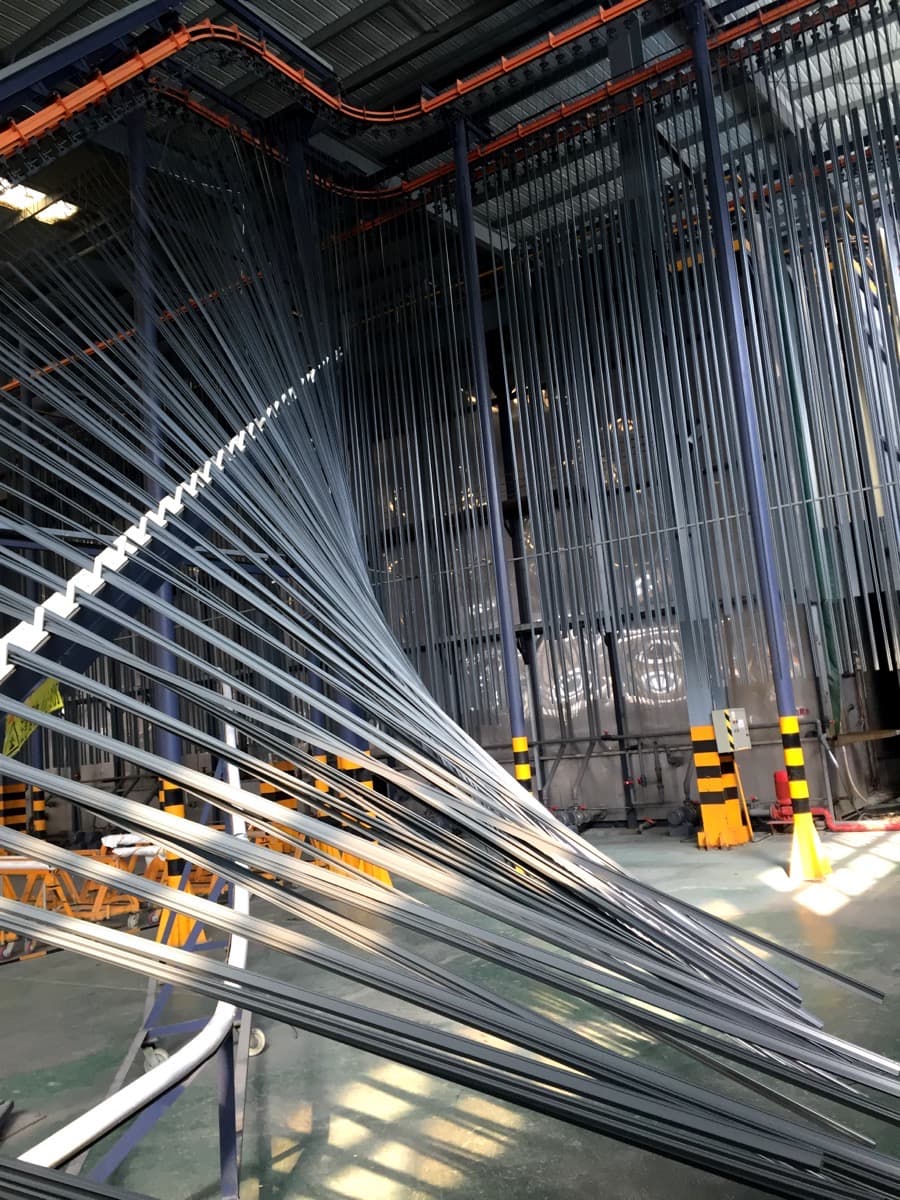
The easiest step to shortcut, and the only one you cannot see
Sealing is time in a tank under control. It changes nothing you can look at. A properly sealed profile and a rushed one arrive on the same truck looking identical — same colour, same gloss, same feel under your thumb.
That is exactly why it is the step under pressure when a finishing line is running behind. Every other shortcut leaves evidence on delivery: a thin coating reads differently in the light, bad racking leaves contact marks, weak pre-treatment shows up as patches. A short seal shows nothing at all, for months.
We are not saying every supplier cuts it — most do not. We are saying it is the one variable in an anodizing quote that a buyer cannot verify by looking, which makes it the one variable worth writing into the order rather than assuming.
What a poor seal looks like, six months later
The complaints arrive in a recognisable pattern, and the pattern is staining rather than failure. Fingerprints from installation that set into the surface and will not clean off. Water spots after rain that a cloth does not take out. A dull bloom across what was a clean satin face. The profile is not corroded — it is absorbing, which is what an open pore does.
On dyed profiles the second symptom is colour instability. Dye sitting in open pores can leach and bleach unevenly under UV, so a bronze elevation drifts — and drifts faster on the side that gets the sun. Two elevations that left the plant matching no longer match, and nothing about the batch record explains it.
In humid, coastal or industrial air, the third symptom is corrosion getting a foothold. An open pore is a direct route down through the coating to the metal — the same mechanism described in our piece on coastal and high-UV projects, arriving through a different door.
None of this is fixable in place. An anodized surface cannot be stripped and redone the way a powder coating can; the finish is the metal. That asymmetry is worth remembering while the order is still being placed.
Dyed and coloured work pays for it first
If the profile is natural silver, a marginal seal is a durability problem that takes time to show. If the profile is dyed — bronze, champagne, black, any of the architectural colours — it is also a colour problem, and colour problems get noticed.
This is the practical consequence: on coloured architectural work, sealing stops being a technical footnote and becomes part of the appearance specification. If the elevation has to stay one colour, the seal has to be as consistent between batches as the dye is.
It is also why we push customers to decide colour before the order is split across batches rather than after. Batch-to-batch shade variation is inherent to anodizing, and a variable seal widens it instead of holding it.
How to actually verify it
Ask which sealing method the line runs. Hydrothermal sealing — hot water or steam — and cold or mid-temperature chemical sealing are both legitimate routes, and they are controlled differently. You are not asking to second-guess the choice; you are checking that the step is run as a controlled process rather than as a rinse. A finisher who cannot answer this immediately has told you something.
Ask for a sealing-quality result. Standard laboratory methods exist for exactly this question — a dye-spot test on a prepared area, an admittance measurement, an acid dissolution test that weighs what the coating loses. You do not need to run any of them. You need to see that someone does, and to see it on paper for your material rather than as a general statement about the plant.
Note that this is a separate question from thickness. Coating-thickness measurement and dimensional inspection are part of our standard quality checks and those reports are available on request; sealing quality is its own test and it is entirely fair to ask for it separately, particularly on architectural, coastal or coloured work.
And ask how the parts are handled after sealing. A freshly sealed surface is still settling, and contamination picked up in that window can set into it. Gloves, clean racking and wrapping are not fussiness at that stage — they are part of the finish.
What to put in the enquiry — and when to push back
Say where the parts end up. Interior shopfitting and a seafront balustrade do not need the same rigour, and a supplier who knows which one it is can quote the right process instead of the cheapest one.
Say whether the profile is dyed and whether the elevation has to stay consistent across batches. Say when the parts are machined, drilled and handled relative to finishing, because every one of those operations happens to the sealed surface.
Then push back in three situations. When the quotation describes only colour and coating class and is silent on sealing. When the question itself is treated as unusual. And above all, when you are told sealing does not matter because the coating is thick — thickness and sealing solve different problems, and a thick coating with open pores is a thicker sponge, not a better finish.
If you are not sure what your application needs, send us the drawing and tell us where the building is. That is a shorter conversation than it sounds, and it is much shorter than the one that starts six months after installation.
Related
Profiles in this guide